

The idea of traveling to other planets using commercial aircraft might seem like science fiction, but let’s explore this hypothetical scenario. With the fastest passenger aircraft available today, how long would it take to reach each planet in our solar system? This article delves into the feasibility, challenges, and estimated travel times for such an extraordinary journey.
The Fastest Passenger Aircraft
Before we embark on this interplanetary adventure, let’s consider the aircraft in question. The Boeing 747-8, known for its impressive speed of approximately 1,136 km/h (706 mph), holds the title of the fastest commercial airliner currently in operation. This speed, while remarkable for Earth-bound travel, pales in comparison to the vast distances between planets. However, for the sake of this hypothetical exploration, we’ll use this aircraft as our baseline.
Understanding Planetary Distances
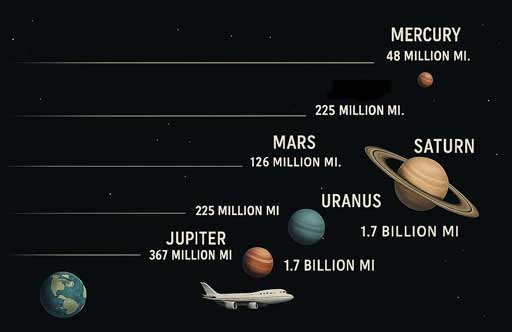
To calculate travel times, we need to understand the distances involved. The solar system is vast, and the distances between planets vary significantly. Here’s a breakdown of the average distances from Earth to each planet, measured in kilometers:
- Mercury: 91 million km
- Venus: 41 million km
- Mars: 225 million km
- Jupiter: 628 million km
- Saturn: 1.27 billion km
- Uranus: 2.72 billion km
- Neptune: 4.35 billion km
These distances are not static due to the elliptical orbits of the planets, but they provide a starting point for our calculations.
Earth to Mercury using a commercial flight
Mercury, the closest planet to the Sun, is also the closest to Earth at times. At a speed of 1,136 km/h, it would take approximately 11.6 years to reach Mercury. This calculation assumes a direct path, which is not feasible due to the need for launch windows and gravitational assists.
Earth to Venus
Venus, often called Earth’s twin due to its similar size, is closer than Mercury at certain points in its orbit. The journey would take about 5.3 years at 1,136 km/h. Again, this is a simplified estimate, ignoring the complexities of interplanetary travel.
Earth to Mars
Mars, a frequent target for space exploration, is significantly farther. Traveling at 1,136 km/h, it would take 9.9 years to reach Mars. This duration highlights the challenges of long-distance space travel, even with the fastest aircraft.
Earth to Jupiter
Jupiter, the largest planet in our solar system, is much farther away. The travel time would be a staggering 79 years. This duration underscores the impracticality of such a journey with current technology.
Earth to Saturn
Saturn, known for its rings, is even farther. At 1,136 km/h, it would take 161.7 years to reach this planet. The vast distance makes this journey seem more like a generational project than a single trip.
Earth to Uranus: The Ice Giant
Uranus, with its tilted axis, is next on our list. The travel time would be approximately 345 years. This duration is longer than many human lifespans, emphasizing the scale of interplanetary distances.
Earth to Neptune: The Farthest
Neptune, the farthest planet from the Sun, would take 552 years to reach at 1,136 km/h. This journey is not only impractical but also highlights the limitations of current aircraft technology for interplanetary travel.
Challenges and Considerations
Atmospheric and Space Environment
Commercial aircraft are designed for Earth’s atmosphere, not the vacuum of space. The transition from atmospheric flight to space travel would require significant modifications, including shielding from radiation and extreme temperatures.
Fuel and Sustainability
The fuel required for such journeys would be astronomical. Even with the most efficient engines, the energy needed to propel an aircraft across millions of kilometers is beyond current capabilities.
Human Factors
Human endurance is another critical factor. Long-duration space travel poses risks to physical and mental health, including muscle atrophy, bone density loss, and psychological stress.
The Role of Technology
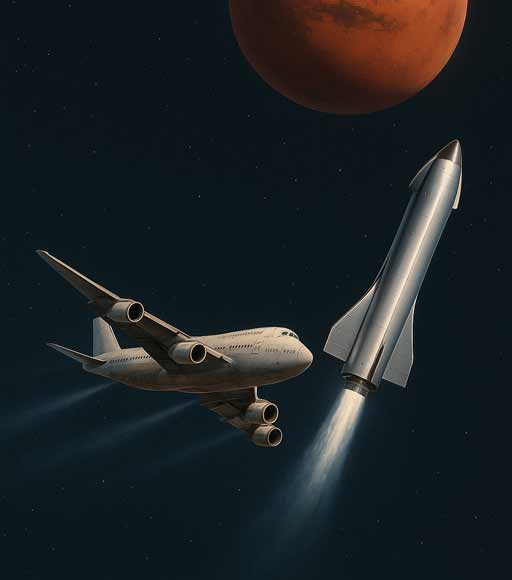
While this scenario is hypothetical, it raises important questions about the future of space travel. Advances in propulsion technology, such as ion drives or nuclear propulsion, could drastically reduce travel times. For instance, SpaceX’s Starship aims to reach Mars in just 6 months, a stark contrast to our aircraft-based estimates.
Conclusion
Traveling to other planets using the fastest passenger aircraft today is theoretically possible but practically unfeasible. The travel times range from 11.6 years to 552 years, depending on the destination. This exploration serves as a reminder of the vastness of space and the need for innovative technologies to make interplanetary travel a reality. As we continue to push the boundaries of science and engineering, the dream of reaching other planets may one day become achievable, not just for spacecraft but perhaps even for advanced aircraft.